Accident Response Made Simple: A Guide for Commercial Drivers
Accidents involving commercial vehicles can happen at any time, and being prepared can make all the difference in the aftermath. Whether you manage a fleet or drive for a living, having a clear plan in place helps protect your drivers, your company, and the public. In this safety bulletin, we’ll break down essential accident response strategies, provide step-by-step checklists, and share practical tips to help you handle any incident with confidence and care.
In this issue:
- Photographing an Accident Scene.
- Checklists Assist Motor Carriers in Post-Accident Activities.
- DOT Clarification for Drivers Using Legal Prescriptions and the Medical Review Officer (MRO) During a Positice Controlled Substance Test.
Companies that operate commercial vehicles must be ready for accidents. Even minor incidents can disrupt drivers and supervisors. It's essential to have a simple and flexible plan that can be put into action at any time. When an accident happens, the company should address several urgent tasks immediately.
- Keep the driver and public safe.
- Reduce the company’s risk and property damage.
- Providing information to law enforcement officials.
- Prevent further damage from the accident, such as hazardous material spills, cargo issues, or vehicle damage.
- Follow all state and federal rules, including drug and alcohol testing if needed.
- Record and secure physical evidence at the scene to prevent loss or damage.
- Identify and obtain contact information for all witnesses.
- Tow the vehicle to a secure location.

Recommendations for a company to prepare for an accident:
- Form an accident response team that includes the safety director, the involved driver, an insurance investigator, the company’s attorney, and, if necessary, an accident reconstruction expert.
- Create an accident action plan that clearly defines the response team’s roles and responsibilities.
- Create a clear written policy for drivers to follow any accident. Include steps for reporting, behavior at the scene, responsibilities, and required drug and alcohol testing.
- Add accident scene training to your new driver orientation program. Make sure drivers understand what actions to take—and what to avoid—if an accident occurs.
- Equip each vehicle with an Accident Kit containing a camera, accident report form, pencil, and clear instructions. Mark the kit with an expiration date that matches the camera’s expiration. Seal the kit to keep materials safe. Train drivers on using the camera properly, including which photos to take and which to avoid.
Photographing an Accident Scene
Photos are essential for documenting accident scenes. Many carriers used to provide disposable cameras, but with digital cameras now common, film development is harder to find. No matter the type of camera, be sure your drivers are trained to use it properly. Without training, drivers might miss important evidence—or take photos that could harm your case in court. Use these tips to help train your drivers:
Photo Tips for Accident Scenes:
- Make sure drivers know how to use the camera or have a digital camera with them. Show examples of good and bad photos.
- Take plenty of photos at the scene. Extra pictures can provide key evidence.
- Photograph all damaged and undamaged areas of every vehicle. Get clear shots of license plates and unit numbers.
- Take photos inside vehicles, including the dashboard, seat belts, steering wheel, pedals, and airbags.
- Photograph the scene from all angles—imagine a box around the area and take a photo from each corner.
- Capture the road leading up to the accident, including skid marks and objects nearby, such as signs or poles.
- Don’t photograph anyone injured or deceased. Do take photos of occupants in other vehicles to document who was present and their condition after the accident.
Question of the Week
I hit a deer, and my vehicle can’t be driven, so I pulled onto the shoulder. Where should I place my reflective triangles to warn other drivers?
Answer: First, activate your 4-way hazard flashers immediately. Next, place the warning reflective triangles as follows: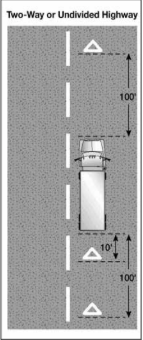
- One on the traffic side of and 4 paces (approximately 3 meters or 10 feet) from the stopped commercial motor vehicle in the direction of approaching traffic.
- One at 40 paces (approximately 30 meters or 100 feet) from the stopped commercial motor vehicle in the center of the traffic lane or shoulder occupied by the commercial motor vehicle and in the direction of approaching traffic.
- One at 40 paces (approximately 30 meters or 100 feet) from the stopped commercial motor vehicle in the center of the traffic lane or shoulder occupied by the commercial motor vehicle and in the direction away from approaching traffic.
Hills, curves, and obstructions:
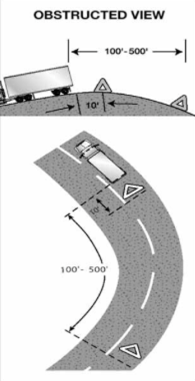
If your vehicle stops within 500 feet of a curve, hill, or anything that blocks the view, place a warning signal 100 to 500 feet in the direction of the obstruction to give other drivers plenty of notice.
Divided or one-way roads:
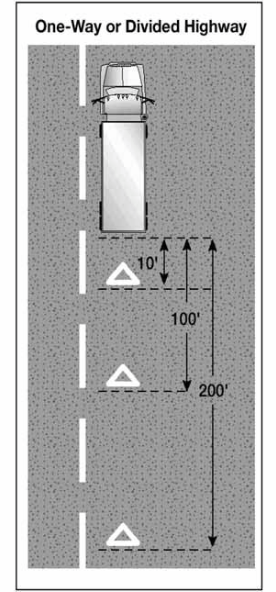
If a commercial motor vehicle is stopped upon the traveled portion or the shoulder of a divided or one-way highway, the driver shall place the warning devices as follows:
- One warning device at 200 feet, and
- One warning device at 100 feet in the direction of approaching traffic in the center of the lane or shoulder occupied by the commercial motor vehicle, and
- One warning device at the traffic side of the commercial motor vehicle within 10 feet of the rear of the vehicle.
Checklists Assist Motor Carriers in Post-Accident Activities
After a DOT crash, use this checklist to guide your next steps:
- If your driver is hurt, contact their family to offer help and support if needed.
- Complete all required drug and alcohol tests for your driver within the 8- and 32-hour deadlines set by §382.303.
- Notify your insurance agency—they can handle most on-scene investigations for you or your attorney, using their own staff or a third-party adjuster.
- If you believe the accident may lead to legal issues, consider hiring an attorney to manage the investigation. This keeps all information organized and protected under attorney work product rules.
As applicable, for liability purposes, capture:
- Keep the driver’s qualification and drug/alcohol records from the day of the crash.
- Keep vehicle records for all equipment involved as they were on the day of the crash.
- Save the driver’s activity records for the last 30 days (shipment paperwork, logs, payroll, etc.). Your attorney may ask for more.
- If law enforcement investigates, give your company’s contact info to the officer.
- Record the accident on your accident register(Section 390.15).
When police inspect your equipment:
- Request a copy of their report right away.
- Get an independent inspection (your insurance company can help).
DOT Clarification for Drivers Using Legally Prescribed Medications and the Medical Review Officer (MRO) During a Positive Controlled Substance Test
40.135; 40.327
QUESTION:
During the verification interview, the MRO might find out about a prescribed medication that could make the employee unsafe or unqualified for the job. By law, the MRO must tell the employee to have their doctor contact the MRO within 5 business days. If the doctor doesn’t call, the MRO will report the issue. Can the MRO report it before the 5 days are up?
ANSWER:
Yes, there could be instances where the MRO does not need to wait the 5 business days, for example:
- If the doctor contacts the MRO before 5 days, but the safety risk is unresolved, the MRO can report it.
- If the employee refuses to have their doctor talk to the MRO, the MRO can report it sooner.
- If the MRO learns the employee is medically unqualified under DOT rules, the MRO must report it right away. The 5-day waiting period does not apply.
Got Chains?
If your state requires chains, ensure they are the correct size, clean, unbroken, and securely stored so you can use them when needed.
Not sure what your state’s chain laws are? Visit: http://www.tirechainsrequired.com/laws.html
The 2025 Idealease/NPTC Fall Safety seminars have concluded!
Idealease and the National Private Truck Council NPTC hosted 8 safety seminars in the fall of 2025. Although the Spring and Fall sessions have concluded, get ready for the next sessions in the Spring and Fall of 2026. The one-day seminars will focus on basic safety and compliance, regulation changes and CSA. The seminars will be provided to all Idealease customers, potential customers and NPTC members at no charge. The seminar provides valuable information applicable for both novice and experienced transportation professionals.
To register for an upcoming seminars in 2026, click on the following link.
http://www.idealease.com/safety-seminar-registration
*The Idealease Safety Bulletin is provided for Idealease locations and their customers and is not to be construed as a complete or exhaustive source of compliance or safety information. The Idealease Safety Bulletin is advisory in nature and does not warrant, guarantee, or otherwise certify compliance with laws, regulations, requirements, or guidelines of any local, state, or Federal agency and/or governing body, or industry standards
Read More Posts