Railroad Crossing Safety for Commercial Trucks
Every year, Daylight Saving Time brings a shift in our daily routines, altering not only our clocks but also the way we experience the road. For professional drivers and fleet operators, these changes can present new challenges, especially around railroad crossings where visibility and timing are crucial. Understanding how to stay safe at crossings and how time changes affect routes is essential for keeping everyone on the road protected. In this post, we’ll explore important safety tips for navigating railroad crossings and how to stay compliant and alert during the transition into and out of Daylight Saving Time.
In this issue:
- Safety Tips for Truck Drivers.
- Know Your Railroad Crossing Signs and Signals.
- Time to Fall Back: Daylight Saving Time Changes on Sunday!
Read, share, and/or print this week's Safety Bulletin.
Check out past Idealease Safety Bulletins.
How often do you cross train tracks without a second thought? Many of us assume it’s always safe, but every crossing deserves your attention.
Safety Tips for Truck Drivers
Five ProDriver Steps to Safely Cross Railroad Tracks
- Silence distractions and stay alert—always look and listen for approaching trains.
- Always stop between 15 and 50 feet from the crossing for a safe view.
- Check both directions twice before crossing. If your view is blocked, never risk it; wait until you’re sure it’s safe.
- Hazmat drivers: Stop at all crossings unless marked “Exempt.” Know your route and the law.
- Commit to crossing once you start; never stop on the tracks. If you stall, evacuate fast and call the emergency number posted at the crossing.
Note: Refer to state and local laws, as well as company policies, for additional information.
Know Your Railroad Crossing Signs and Signals
Additional Recommendations for Navigating Train Crossings:
- Trains and trucks don’t mix. Never race a train to the crossing; even if you tie, you lose.
- Trains can appear farther away and slower than they actually are. Always wait until the train has passed fully and the way is clear before crossing.
- Remember that trains cannot stop quickly. A freight train traveling at 55 mph may need over a mile to come to a complete stop; that’s the length of about 18 football fields.
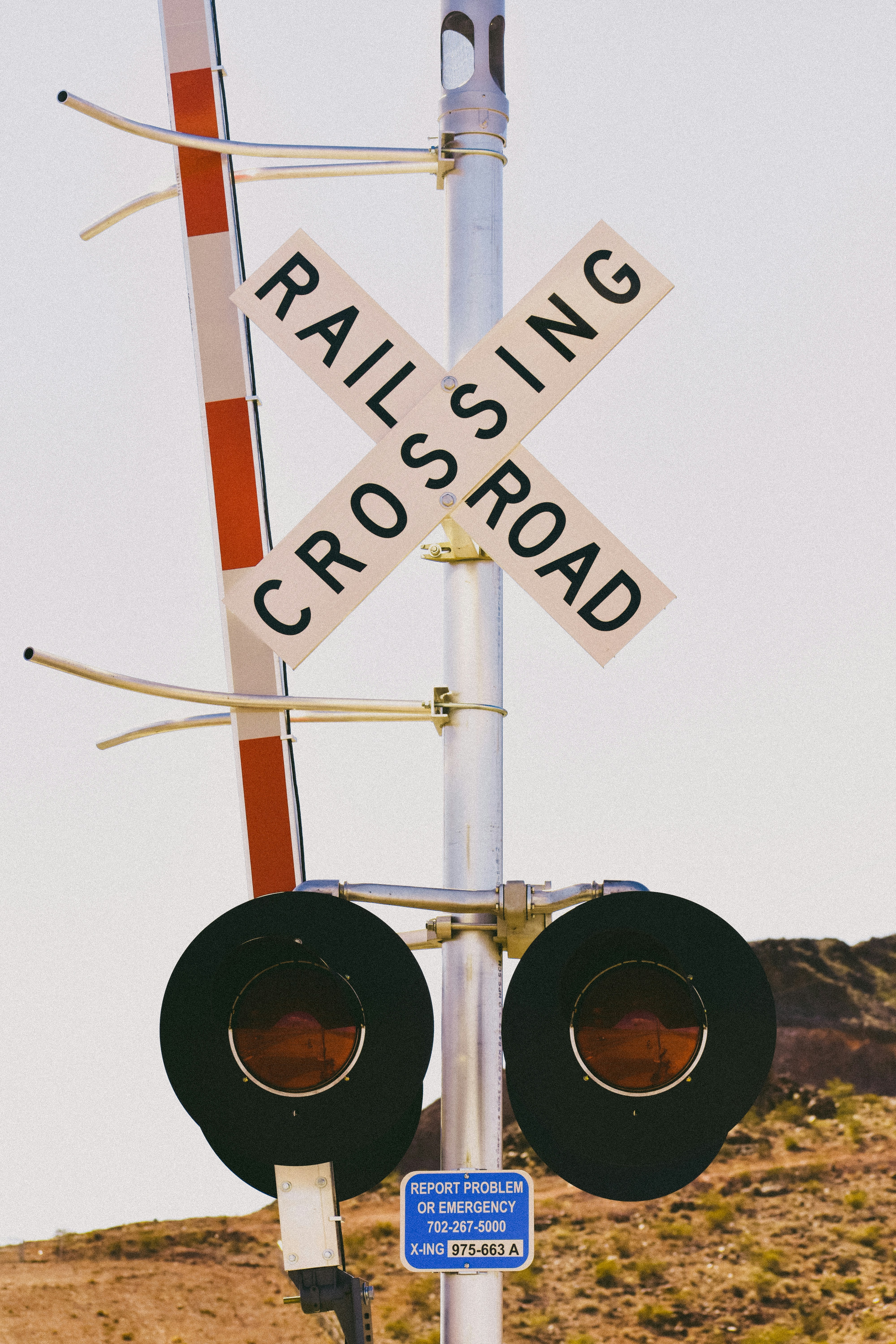
- Never drive around lowered gates; it’s illegal and extremely dangerous. If you suspect the signal is malfunctioning, use the posted 1-800 number or contact local law enforcement immediately.
- Always ensure that you can completely clear the crossing before proceeding; never get trapped on the tracks. Trains are typically about three feet wider than the rails on each side, so give yourself plenty of space.
- If your vehicle stalls on the tracks and a train is approaching, exit the vehicle immediately. Move away from the tracks in the direction the train is coming from; this helps protect you from flying debris. Once safe, contact local law enforcement for help.
- At crossings with more than one track, be sure to look for a second train approaching from either direction before crossing.
- Cross only at designated railroad crossings. Always look both ways and cross swiftly, and never stop on the tracks or closer than 15 feet from the rails.
- Always expect a train, even if you don’t see one. Freight trains often do not follow set schedules, so stay vigilant at all times.
- If your vehicle becomes stuck on the tracks, get out immediately and call the emergency number posted at the crossing, or contact local police to notify the railroad of your position as soon as possible.
(Information provided by Operation Lifesaver.)
About Operation Lifesaver
Operation Lifesaver, Inc. is a national nonprofit safety education organization dedicated to eliminating deaths and injuries at railroad crossings and along railroad rights of way. The organization operates in all 50 states with trained and certified presenters who provide free safety talks to community groups, school bus drivers, truck drivers, and student drivers.
For more information or to request a free safety presentation, visit www.oli.org.
New Operation Lifesaver Video Warns: Filming on Train Tracks Is Illegal and Deadly!
With the rise of social media, there have been several tragic incidents involving people making videos near railroad tracks. Operation Lifesaver, Inc. has released a new animated video warning amateur filmmakers and smartphone users about the dangers and illegality of using train tracks for videos.
This video is part of a broader campaign that highlights the dangers of illegal and unsafe behavior around train tracks.
Time to Fall Back: Daylight Saving Time Changes on Sunday!
Daylight Saving Time ends at 2:00 a.m. on Sunday, November 2nd. Remind all drivers about this change, as daylight patterns will shift. Intersections and streets may look different due to the sun’s new position, and even a one-hour change can affect visibility and driving conditions.
How Electronic Logging Devices (ELDs) Handle Daylight Saving Time
Since electronic logging devices (ELDs) became federally mandated in 2017, most systems automatically adjust for Daylight Saving Time changes. Regardless of whether you are springing forward or falling back, drivers are still required to follow all DOT and FMCSA Hours of Service regulations.
For example, if you work from 1 a.m. to 10 a.m., your log will show nine hours worked even though the clock falls back one hour. If you begin a 10-hour break at 10 p.m. on Saturday, it will end at 7 a.m. on Sunday instead of 8 a.m. due to the time change. You are still required to complete a full 10-hour break and follow all Hours-of-Service rules. The same principle applies to the 34-hour restart. You may reach it an hour earlier, but you must still complete the full 34 hours.
How DST Affects ELD Logs:
- Duty statuses before the change will show “Daylight Time” (EDT, CDT, etc.), while those after will show “Standard Time” (EST, CST, etc.).
- On November 3rd, your log will total 25 hours.
- For tablets with HOS functionality, the system will automatically adjust one hour back at 2 a.m. according to your home terminal’s time zone.
- For paper logs, note the change by writing “Fall Time Change” in the remarks section.
The 2025 Idealease/NPTC Fall Safety seminars have concluded!
Idealease and the National Private Truck Council NPTC hosted 8 safety seminars in the fall of 2025. Although the Spring and Fall sessions have concluded, get ready for the next sessions in the Spring and Fall of 2026. The one-day seminars will focus on basic safety and compliance, regulation changes and CSA. The seminars will be provided to all Idealease customers, potential customers and NPTC members at no charge. The seminar provides valuable information applicable for both novice and experienced transportation professionals.
To register for an upcoming seminars in 2026, click on the following link.
http://www.idealease.com/safety-seminar-registration
*The Idealease Safety Bulletin is provided for Idealease locations and their customers and is not to be construed as a complete or exhaustive source of compliance or safety information. The Idealease Safety Bulletin is advisory in nature and does not warrant, guarantee, or otherwise certify compliance with laws, regulations, requirements, or guidelines of any local, state, or Federal agency and/or governing body, or industry standards
Read More Posts